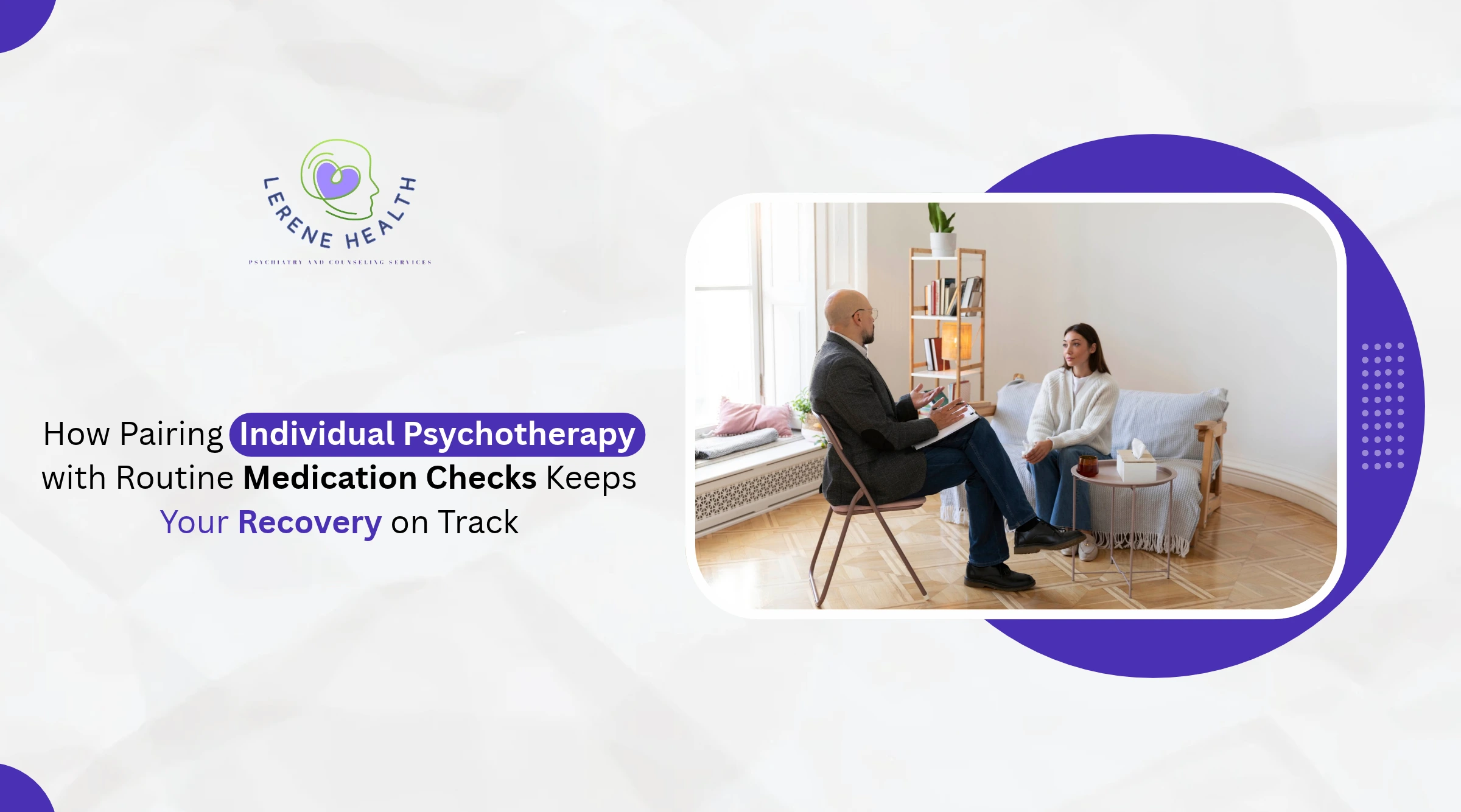
Both therapy and medication checks are used for different reasons. Therapy provides you with the skills to help you cope, think and react.
Medication checks ensure that your current prescriptions are still appropriate!
When you combine these two services then problems can be identified quickly and before they negatively affect your progress. Therefore, many people do find that they are able to achieve more positive outcomes when they receive both services, rather than just one.
Now, picture this. You have been taking your meds for a couple of months and are feeling great. Therefore, you do not attend a follow-up appointment. Next, your work life becomes chaotic, your sleep pattern is disrupted, and that familiar weight begins to slowly return.
Or even switch things around. You’re going to see your therapist once a week but your anxiety is through the roof, and no one has evaluated your medication dosage in over a year.
Both stories are common. And both are fixable.
In this article:
- What therapy does, and what medication checks do
- Why the two work better as a pair
- What happens when you only do one
- How often to go
- Signs your recovery needs attention
- A simple plan for your first 30 days
Related reads from Lerene Health:
- How Untreated Adult ADHD Impacts Workplace Focus
- How to Tell If Your Daily Anxieties Are Just Part of Life Or If You Have Clinical OCD Symptoms
- Why Evidence-Based MAT Is Effective for Substance Use Disorders
What Does Each One Actually Do?
They sound alike. They’re not.
- It’s a private, one-on-one talk with a therapist
- It helps you spot patterns in how you think and react
- You pick up practical skills, like calming your body or reframing a thought
- You work through stress, relationships, grief, and old pain
- They are short, targeted visits that address symptoms, sleep, appetite and side effects.
- They make sure your dose still fits
- They adjust the plan when your life changes
Think of it like this: Medication turns down the volume of the noise. Therapy teaches you how to function when the noise is gone.
Why Do They Work Better Together?
Each one covers what the other can miss.
- Using medication may assist in using therapy. It will be easier for you to use new skills if your thoughts are not racing and you have energy left.
- Pills give you something that therapy cannot. A pill cannot teach you how to manage a difficult conversation. It cannot help calm your racing heart at 3:00 a.m. when you are experiencing a panic attack.
- Your therapist watches what you do each day. She/he notices when you are feeling down, having trouble sleeping, or experiencing a lot of stress.
- Your doctor will look at the medical aspects of your treatment. They will be looking for dosage issues, potential side effects, and any other health related problems.
- You get two sets of eyes. If something’s off, someone spots it sooner.
- You get a cushion. When life gets rough, you already have people in your corner.
Research regarding depression is consistent with this finding. According to a large review published in JAMA Psychiatry, adding psychotherapy following a successful response to antidepressants is associated with reduced risk of relapse. However, there is no single solution for everyone. The degree to which combining these treatments will help you will depend upon your specific diagnosis, the severity of your symptoms, and the types of treatment that you have previously attempted.
What Happens If I Only Do One?
Medication alone and therapy alone can both help. They just have gaps.
Medication only:
- Symptoms may ease, but the habits behind them often stay put
- It’s easy to feel fine and drift away from follow-ups
- Side effects can linger when nobody’s asking
- Stress can bring symptoms back, and you may not have tools ready
Therapy only:
- Focus is hard to find when symptoms are heavy
- Some conditions respond better with a medical option added
- You might feel like you’re working hard and getting nowhere
Neither option indicates that you have failed. Your plan may require an additional component. Also, there are individuals who succeed using only one method; therefore, a competent provider should discuss this option with you prior to making assumptions.
What Happens at a Medication Check?
Your prescriber wants to hear how things are really going.
Expect questions like:
- How are your mood, anxiety, focus, and sleep?
- Any side effects?
- Are you taking it as prescribed? (Missed doses happen. Be honest.)
- Are you using alcohol or other substances?
Then, depending on what is needed, they may leave your treatment plan unchanged, modify your dosage, switch you to a different medication, and/or request blood tests.
Please do not stop taking your medication, nor should you alter the way in which you take it without consulting with your physician. Stopping your medications abruptly can result in severe side effects for some of the medications that are available today. If you feel like something is wrong, please contact your physician as soon as possible.
How Often Should I Go?
That depends on you. Here’s a rough guide.
- Just getting started: Therapy is typically conducted once a week. Prescribers typically visit with patients on a more frequent basis than that (to determine if the patient has had an adequate response to medication, and to monitor the potential development of side effects).
- Feeling better: Therapy may drop to every other week. Checks get spaced out.
- Stable: Therapy as needed, plus routine check-ins to confirm things still work.
- Rough patch or large change: Include session(s). Verify (check) if there has been a change in your symptoms or side effects.
The most important word here is “routine.” Checks are not only used during emergency situations, but also as a means to prevent small issues from becoming larger ones.
What Are the Signs My Recovery Needs Attention?
One bad week doesn’t send you back to square one. But a pattern deserves a call.
- Symptoms coming back or getting worse
- Sleeping a lot more or a lot less
- Pulling away from friends and things you enjoy
- New side effects, or old ones that won’t go away
- Skipping doses or running out early
- More drinking or substance use
- Feeling numb, flat, or “not like yourself”
- Thinking, “Maybe I don’t need this anymore”
The last item should be discussed, rather than quietly decided upon. If you are feeling better, it is likely that your treatment is working.
If you are considering self-harm or harm to others, contact 911, or call/text 988. If there is a possibility that your life is in danger, please go to the nearest emergency department.
Who Can This Approach Help?
At Lerene Health, we work with adults on:
- Depression
- Anxiety
- OCD
- ADHD
- Mood disorders
- Substance use disorders
In certain cases, the combination of services is more important than in others. For example, medication-assisted treatment for substance abuse works better when combined with counseling. When someone has depression that has been resistant to other types of treatment, there are also options available such as Spravato (esketamine), which is administered under the supervision of a physician.
Not every option fits every person. That’s what the evaluation is for.
Can I Do This Through Telehealth?
Generally, yes. Follow-ups are usually much simpler using telehealth. There is no travel required to go to the clinic and you can take care of your medical needs without missing any work.
People can begin with face-to-face sessions and then transition to online sessions at a later date. Also, people may find that early morning and late night session times are more convenient for their schedules.
Your First 30 Days: A Simple Plan
- Week 1: Schedule an appointment for a psychiatric evaluation if you have not done so. List your top three concerns.
- Week 1: List every medication and supplement you take.
- Week 2: Start your therapy. Tell the therapist what you are looking for in terms of outcomes (e.g. if you want to be less overwhelmed).
- Week 2: Keep a short daily entry about how you are feeling (mood), if you slept well (sleep), and any problems with the medication (side effects). A single sentence will do.
- Week 3: Bring those notes to your first medication check.
- Week 4: Look back. What’s better? What isn’t? Tell both providers.
How Lerene Health Can Help
At our practice, we provide a full range of mental health services including psychiatric assessments, medication management and individual psychotherapy to adults (18 years old or older). We are located in Voorhees Township and Berlin, New Jersey, and also provide telehealth.
Would you like to find out more first? Look through our FAQs, find out how we operate, and find out about the latest updates to our blog.
Frequently Asked Questions
Is it better to do therapy and medication together?
In general terms, for most individuals, yes. Therapy assists in building strategies to deal with issues, medications relieve symptoms and periodic reviews assist in maintaining your strategy on course. Some people, however, may be able to function effectively using only one of these options. Your provider will assist you in determining what is appropriate for you.
How often should I have medication checks?
Usually, the first few times will be more frequent. After you’re stable, the frequency should decrease. Your doctor determines the timing of these appointments. Always attend each of your scheduled appointments regardless of how well you feel.
Can I stop my medication once I feel better?
Feeling better usually indicates that the medication is working. Your doctor will be able to assist with taking you off of the medication safely, if desired.
Take the Next Step
You don’t have to piece this together alone.
- Book an appointment
- Call 856-208-5798 (Monday to Friday, 7:30 a.m. to 6:30 p.m. ET)
- Contact us
- See all services
Sources and further reading:
- Guidi J, Fava GA. Sequential Combination of Pharmacotherapy and Psychotherapy in Major Depressive Disorder: A Systematic Review and Meta-analysis. JAMA Psychiatry. 2021.
- Combined Psychotherapy and Pharmacotherapy for Mood and Anxiety Disorders in Adults: Review and Analysis. FOCUS, American Psychiatric Association.
- 988 Suicide & Crisis Lifeline
The purpose of this article is to educate you. It is not intended to provide medical advice. Before you make changes to or discontinue taking any of your prescribed medications, consult with your healthcare professional.